Considering the proliferation of The Conjuring films over the last few decades, it can be difficult to distinguish a film about a medium from the usual James Wan joint. It’s a pleasurable surprise, then, that writer/director Dave Boyle‘s Never After Dark feels both unique and familiar.
The 2026 film, which performed well on the festival circuit at both The Overlook Film Festival and SXSW, focuses on a work-for-hire medium named Airi (Shogun‘s Moeka Hoshi). When the film begins, she’s been hired by a rich mother and son duo – Teiko (Tae Kimura) and Gunji (Kento Kaku) – to help deal with a ghost that’s been spotted lurking around their newly acquired hotel in the isolated Japanese woods.
One of the joys of Never After Dark is the ease with which Boyle doles out backstory and exposition. As Airi drives, she playfully chastises her sister Miku (Kurumi Inagaki) in the backseat for not wearing her seatbelt, but when the medium arrives, Teiko and Gunji both comment in surprise that she’s arrived alone. It’s then that we realize that a) Miku isn’t alive and b) Airi is a real medium (because she can see the dead). While the “dead companion” has become an overused trope in horror (and, more broadly speaking, entertainment in general), Boyle knows exactly how much to use Miku in order to ensure that the character doesn’t become a nuisance (Importantly she’s also not a hallucination; Airi is actually communicating with her dead sister in various reflective surfaces throughout the film).
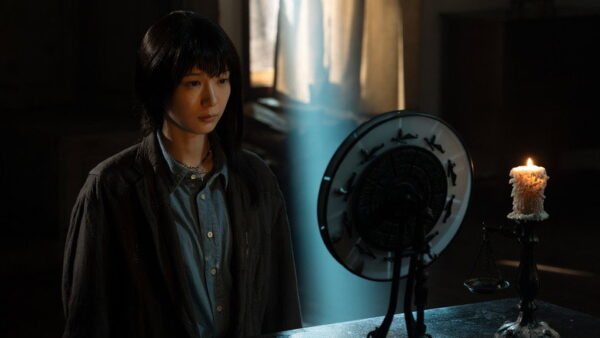
The central mystery of the film surrounds Airi’s efforts to communicate with the hotel’s ghost, The Gaping Mouth Man (Mutsuo Yoshioka), whose name is apt given his gnarly facial wound. One of the elements that sets the movie apart is the low-fi mythology Boyle creates for how Airi traverses the veil between the living and the dead. The process involves a specific candle, dimming the lights, burning a lock of her hair and entering a fugue state using a spinning zoetrope. Once she’s on the other side, the rules of interaction change, which makes for at least two exciting set pieces when Airi finds herself threatened and unable to return to the real world where she’s safe.
Never After Dark‘s story is surprisingly simple and even borders on straightforward: there’s the mystery involving The Gaping Mouth Man (his identity; his motivation; and how to get him to move on) and just how Airi will accomplish this act. What makes the film stand out are Boyle’s subtle tweaks to this formula, as well as the exceptional technical execution, including Boyle’s direction and Yûji Hayashida‘s handsome production design.
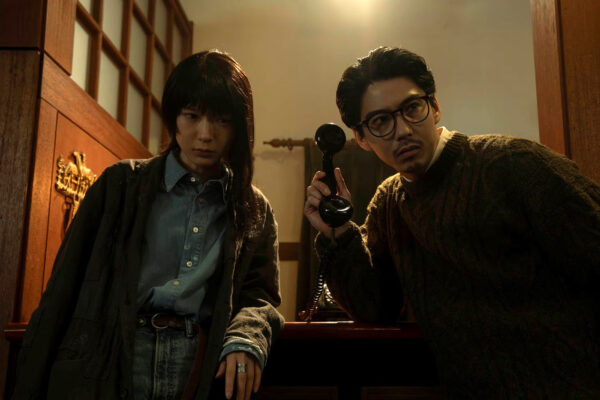
First and foremost, the film is *gorgeous* to look at. The interior of the enormous hotel is all wood panels and lush carpeting, spread out across multiple levels with plenty of closed doors that creep open or hide secrets. Boyle and cinematographer Patrick Ouziel keep the camera moving, tracking high above hallways or swooping into the open lobby to create visual interest as Airi explores her new surroundings. The hotel is as much of a character as she is, and the ease with which the layout of the interior space and the geography of the surrounding woods is established is impressive.
Helping matters is Hoshi’s calm and confident central performance. Airi is an intriguing protagonist, in large part because she never loses her cool even when things become increasingly dangerous and uncertain. Her tendency is to stay away from the living, so every appearance by Teiko and Gunji (who are meant to leave the grounds while Airi works, but keep mysteriously returning) feels like an intrusion. But there’s also a vitality to the medium, captured perfectly in an extended sequence in which she takes the night off to drink beers and dance around the hotel. It’s a great sequence that allows the audience some interiority into a character who occasionally feels one step removed from us.
Alternately beautiful, mysterious, and – especially in its action-packed climax – exciting, Never After Dark is an unexpected delight. Expertly crafted by Boyle (who immediately becomes one to watch), it’s no surprise the film caught on with festival audiences. Seek this one out. 4.5/5
Never After Dark is in theatres Sept 25
Leave a Reply