
Merging Marriage Story with Jurassic Park sounds like a recipe for disaster, but writer/director David Robert Mitchell (It Follows) mostly manages to make The End of Oak Street work.
[Read more…]The curated portfolio of film journalist Joe Lipsett
Merging Marriage Story with Jurassic Park sounds like a recipe for disaster, but writer/director David Robert Mitchell (It Follows) mostly manages to make The End of Oak Street work.
[Read more…]
Some films have a temperature associated with their colour scheme. Cool blues, disaffected greys, and earthy greens.
Corpus, writer/director Corrin Evans‘ 90s-set hallucinatory erotic thriller (but not in that way) is full of golden ambers and harsh oranges. It’s a film that feels sweaty and hot; the characters flit between rooms and scenarios in a daze – be it from the booze, the drugs, or good old fashioned lust (or some combination of all of the above).
Sayo (Jeff Wahlberg) is a low-level coke dealer and aspiring photographer living in New York. It’s late June, 1997 and Sayo is aimlessly passing through life, shooting anything that captures his eye on the street or at the gay bar. It’s quickly made clear by his vaguely misogynist friend Ross (Michael Vlamis) that the photographer is on the outs with their mutual friend Vince (Brodie Townsend), an up and coming celebrity whose chiseled jaw and cheekbones are prominently displayed on the cover of a magazine.
The tortured relationship between Sayo and Vince is the core of the film, and will feel relatable to any queer person crushing on someone in the closet or, more broadly speaking, a hook up that refuses to acknowledge you in the cold light of day as anything other than “a friend.”
The reality is that there is something going between Sayo and Vince (the sexual chemistry leaps off the screen whenever they’re together) and it’s evident that Vince can’t handle it because of his burgeoning fame. But he also can’t let Sayo go or stop leading him on, crashing in his bed after a night out partying and demanding Sayo accompany him – for professional reasons, of course – to a party hosted by influential photographer Billie (Lily Cowles) that weekend.
Of course, by the time Vince extends the invite, Corpus has already thrown up a number of red flags. The film’s cold open introduces Billie shooting a demure young woman, Wren (Nuha Jes Izman), in a photo shoot that quickly escalates into an uncomfortable, sexual assault-coded experience. When Vince, Sayo, and Ross arrive for the party, they discover an isolated, derelict country mansion located hours outside of the city. And there’s something odd about Billie, her older “friend” Cata (Ching Valdes-Aran) and a now feral Wren. In fact, none of them seemed to know Sayo or Ross were even coming.
Corpus spends the rest of its runtime teasing a series of weird and wild interactions that would send any reasonable person running back to the city. It’s here that Sayo’s push/pull relationship with Vince comes into play: despite all of the odd behaviour, including Wren murdering a chicken in front of their eyes, which is then served raw for dinner, Sayo can’t bear to stray from Vince, who continually leads the photographer on with his toxic, gaslighting behaviour.
Sayo could be a frustrating character if his relationship with Vince weren’t so well established. Despite how obvious it is that Vince is bad for him, it’s hard not to root for the two men to get together. Evans, who co-wrote the script with Crowes, weaves elements of gaslighting, obsession, and toxicity into Sayo and Vince’s interactions, which are frequently presented in tight, intimate shots or framed fetishistically by emphasizing individual body parts such as lips and eyes, or fingers grazing over bare skin.
It’s undeniably hot, even if it feels as though Vince, the script and the camera are edging Sayo (and, by extension, the audience) with the promise of sex. To be clear: there is man-on-man contact in Corpus, but even when Vince acquiesces to kiss Sayo, or touch his crotch, or go even further, it is almost inevitably accompanied by feelings of guilt, resentment, or vague disgust. These intimate encounters come off as simultaneously wrong and incredibly right; they’re emblematic of the internal conflict between what Sayo wants and what he knows he should refuse for his own emotional well-being.
So, too, is the depiction of their physical connection, which walks a carefully negotiated line thanks to Evans’ history working as an intimacy coordinator. The rollercoaster of emotions that accompanies the hot and heavy (verging on non-consensual) scene between the boys in a blood-red dark room late in the film is a perfect encapsulation of the fine line Corpus is walking.
Of course, Sayo’s attraction to Vince is not the only danger lurking in the castle, something that the film never tries to hide. Still, it is surprisingly how much mileage the film gets from teasing out how uncomfortable and odd the social situations involving Billie, Cata, and Wren are. The threat of (often sexually coded) violence is constantly bubbling under the surface.
That threat is most clearly embodied in a singular, evocative instrument: a distinctive mask/headpiece designed by Miodrag Guberinic of Mio Design NYC that is worn over a character’s head and prominently features a vertical shaft that ends in a multi-pronged fist of spikes. Introduced in the cold open, the mask is prominently displayed like a piece of art in Billie’s home before it is brought to the forefront for an unexpected purpose in the last act, accompanied by some truly incredible looking practical effects.
To say more would be to give away Corpus‘ secrets and this is a film that deserves to be feasted upon. Boasting a dirty, sweaty fashion shoot visual aesthetic and a central queer relationship that is undeniably erotic yet toxic, Corpus is surprising, audacious, and just the right amount of perverted. 4.5/5
Corpus made its world premiere at the 2026 Fantasia International Film Festival

The premise of Godhead, the latest from writer/director Mark H. Rapaport (Hippo), is fascinating: a pair of fraternal twins arrive at an empty church and demand that the Father (Al Warren) identify, then kill whichever one of them is the Holy Spirit.
As a concept, this is filled with potential. Not only for the religious dilemma of a man of the cloth being made to murder someone, but as a twist on the traditional home invasion subgenre, wherein unhinged individuals whose actions can’t be predicted force themselves into a sanctified environment. Add to this the fact that Father isn’t everything he appears to be, and there’s plenty of simmering tension and conflict to go around.
The problem is that Rapaport’s script never fully capitalizes on its potential, instead settling into countless heady conversations that feel more indebted to his prose than contributing meaningfully to the narrative.

It’s a shame because there’s plenty to recommend about the film: first and foremost the performances by the actors playing the twins. The pair are never named (as they explain, they don’t believe in Christian traditions), so they’re only known as Firstborn (Sarah Coffey) and Secondborn (Kimball Farley, reuniting with his Hippo collaborator).
Coffey is the clear standout of the two, principally because she has vastly more dialogue than her nearly mute brother. She handles Rapaport’s dialogue best, infusing the character’s religious-tinged sentiments with a combination of disdain, simmering aggression, and piety. It’s a captivating performance, especially the charged encounter she shares with Father in his car as Firstborn reveals what she knows of his past and how events have been engineered to guarantee their encounter.
Farley is, by necessity, quieter and more introspective (the character’s backstory suggests that he is minorly developmentally delayed because Firstborn temporarily asphyxiated him in the womb), but the kinder, gentler of the twins swings like a pendulum between naïve innocent and violent enforcer. Farley and Coffey play off each other well and the sibling connection, as well as their religious mania, is exceedingly believable.
Warren has the most difficult role because Farley is partially the audience’s proxy so the character spends a lot of his time poking holes in the twins’ story (the vast majority of the film is posed as a theological debate about whether the twins are telling the truth). Intriguingly, Father himself is no saint: he is introduced from the outset as a liar who has been raising a pre-teen son (an under utilized Luke Speakman) in secret after discovering the baby on the church’s doorstep. As a result, the boy, Michael, has never been allowed outside, lied to by Father that the outside world is unsafe and plagued by end of days-style catastrophes.

This complicated backstory alone should make Father extremely compelling, but by hinging the narrative on his disbelief, Godhead tends to run in circles or avoid its most intriguing aspects. Rather than get to the bottom of Firstborn and Secondborn’s claims, Father tends to spend his time attempting to debunk them as liars or simply escape. One crucial early scene all but confirms the reality of what is happening, but Father handwaves it away.
The result is a number of lengthy back and forth conversations between him and Firstborn (and, to a lesser extent, Secondborn) that revisit variations of the same content again and again. The performances carry these scenes, but it sometimes seems as if Rapaport is needlessly delaying the film’s reveal rather than allowing the film to unfold organically.
Caveat: it’s entirely possible that these sequences will play better for individuals with a stronger religious background or faith.
Despite this, the film is eminently watchable. While the action is mostly restricted to a single location – the church – Rapaport ensures that the film is never stagnant. He and cinematographer William Babcock regularly vary the shot composition and keep the camera moving and the inky black and white color palette plays into the film’s moral dilemma (admittedly, Godhead’s visual aesthetic and thematic interests made it was difficult not to compare the film with Mark O’Brien’s similar, but more narratively satisfying The Righteous).
Ultimately Godhead is a challenging film to fully recommend. Its scripting issues are frustrating and make the film feel both longer and more drawn out than its 99 minute runtime. And yet, the undeniably well-made film features two compelling performances by the twins and the mise-en-scène is sumptuous. All in all, Godhead is a half-way there kind of production. 2.5/5
Godhead had its world premiere at the 2026 Fantasia International Film Festival

There’s endless content to be mined from the story of a gaslit woman, which is one of the reasons the “is she crazy or is it really happening?” narrative thread has been pulled so many times in genre films. It’s easy to execute poorly, however, since the answer is almost always: yes, it’s really happening.
Affection, the feature film debut from writer/director BT Meza, takes a slightly different route. By centering Ellie (Jessica Rothe)’s experience as a woman who wakes up married to a man she doesn’t recognize, with a daughter she doesn’t know, in an isolated country farmhouse, the audience is immediately aligned with her confusion and terror.
Even more importantly, however, it’s pretty evident that Ellie, who actually identifies as Sarah, isn’t mistaken. There is definitely something going on, and the truth of the film (which I won’t reveal) is laid out by the end of the first act. This is wise because instead of drawing things out, Affection is afforded plenty of time to explore the implications of what is actually going on.
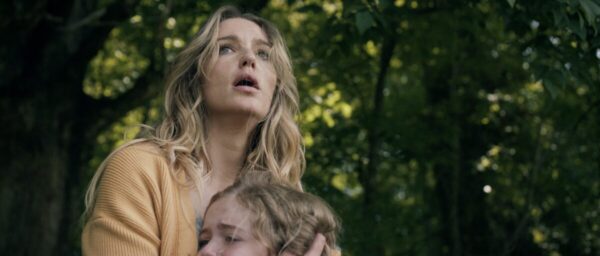
The truth about “husband” Bruce (Joseph Cross) and “daughter” Alice (Julianna Layne) is both simple and complicated. To be clear: the details of how the plot works are a little wonky (though not so difficult to follow that it undermines the film), but it hardly matters thanks to Rothe’s performance.
As a woman questioning her reality; who is contending with a whole separate set of memories; and who is prone to tremors and seizures, Rothe is put through the wringer in Affection. It’s a performance that is equal parts emotional and physical and Rothe negotiates every twist, every reaction, and every histrionic outburst, with ease and believability.

The talented star of the Happy Death Day films nearly runs away with the film (it’s truly her movie), but she has an assist from Cross, who does an excellent job of threading the needle between adoring husband and suspicious abuser. It’s clear that Bruce isn’t telling Ellie the whole truth, but Cross’ performance is carefully calibrated so as to inspire uncertainty about his intent more than anything.
As for Layne, she’s cute (she’s a kid in a horror film who frequently has to be scared and, in that capacity, she does what’s required of her).
The isolated farm setting – nestled against a threatening forest with a bonus corn crop to hide in during tense sequences – also works in the film’s favour. It’s a small production, with only three actors appearing on screen, and while the film doesn’t have quite enough substance to merit the runtime, Rothe’s all-in performance ensures Affection is never boring.

Bottom Line: Affection is another great showcase for Jessica Rothe’s talents. While the film feels slightly drawn out, the actress’ dedication to the role, particularly its physical demands, are impressive and merit a watch. 3.5/5
Affection is out in limited release on May 8.

Writer/director David Lowery‘s latest pits Michaela Coel against Anne Hathaway in a tale about estranged creative collaborators who can’t keep themselves from falling back into each other’s orbit.
[Read more…]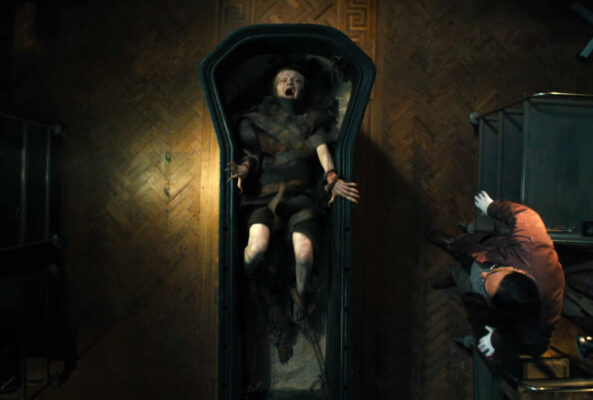
Allegedly Lee Cronin turned down the opportunity to direct a sequel to Evil Dead Rise in order to tackle a new take on the Universal Monster classic. But Lee Cronin’s The Mummy asks: what if he actually *did* make that Evil Dead sequel, just under a different name?
[Read more…]