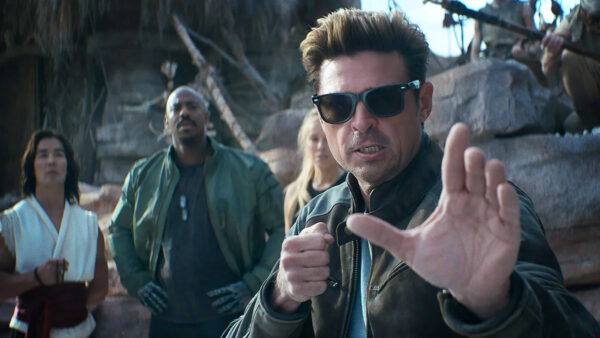
After foregoing the tournament entirely in the first film, Mortal Kombat 2 finally delivers on the inter-dimesional fight to save Earthrealm.
Let’s get this out of the way first: despite focusing on the actual plot of the game series, there’s a threadbare plot keeping the sequel together and there’s a ton of fan service. It’s not a good film, but for fans of the Ed Boon games, the original 90s Paul W.S. Anderson film, or schlocky action films that don’t take themselves seriously, this is a good time.
What’s most surprising is the net zero effect of introducing The Boys star Karl Urban as fan favourite Johnny Cage. What seemed like inspired casting when it was announced proves to be more of a distraction as Urban principally recycles his character from the Eric Kripke series (albeit with fewer “cunts”). Much like the overall quality of the film, it’s not that Urban is bad, but neither screenwriter Jeremy Slatter nor returning director Simon McQuoid have much for the New Zealand actor to do other than lean on his natural charisma.
Introduced via a snippet from one of his many passé action films*, Johnny is a washed out, former has been. Following a cameo by Boon (as a bartender), Johnny is recruited by Raiden (Tadanobu Asano) and Sonya Blade (Jessica McNamee) to fight in the tenth MK tournament orchestrated by Outworld Emperor Shao Kahn (Martyn Ford) in his bid to take over Earth. Naturally Johnny has to go from doubting Thomas to champion, which is a tried and true narrative arc, but also a tired trope.
*Not helping matters: it’s almost identical to Linden Ashby’s introduction in the 1995 film
What both helps and hinders this is the fact that Johnny is not the actual protagonist of the film. Mortal Kombat 2 is equal parts team-up film (as Earth’s heroes band together to defeat their opponents) and revenge narrative (for Adeline Rudolph‘s new character, Princess Kitana – who is the film’s real protagonist).
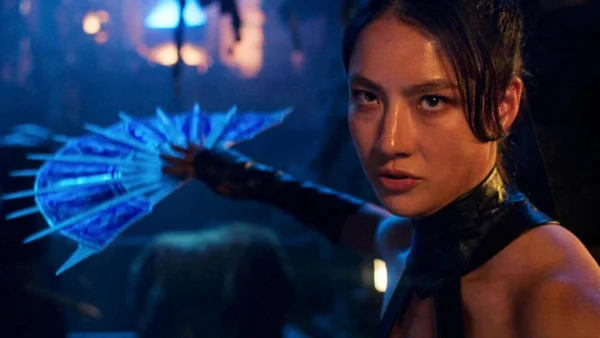
Slatter makes her status clear by opening MK2 with an extended sequence of a young Kitana (Sophia Xu) being forced to watch as her father, King Jerrod (Desmond Chiam), is killed by Shao Kahn in an earlier tournament. Since then, she has been trained as a warrior by sister/mentor figure, Jade (Tati Gabrielle), while supporting the rebellion by secretly collaborating with Raiden. The revenge storyline is another familiar trope, but the film puts most of its emotional energy into this portion of the film (while thankfully also eschewing any romantic subplot) and Rudolph acquits herself well.
It’s the smartest decision the overstuffed and occasionally aimless film makes. Unlike the 2021 film, which simply introduced a bunch of characters, MK2 at least has the tournament to act as a structure to hang the narrative on. Still, it suffers from a nagging feeling that we are simply toggling back and forth between a barrage of repetitive fight sequences and shoe-horning in video game characters in the name of fan-service.
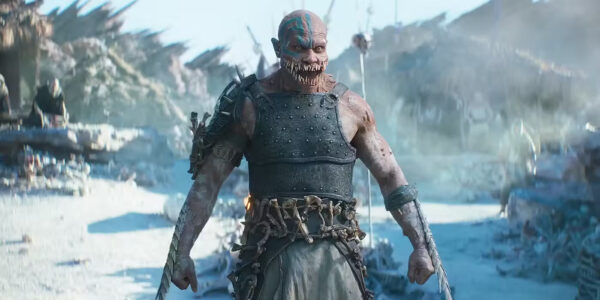
The best example of this involves a detour to win over Baraka (CJ Bloomfield), a pale, bald, toothy-mouthed monster who can shoot blades from his arms. This tangent fares best because it features Johnny’s wisecracking mouth earning him a smackdown, while also striking the right balance between comedy and action.
There’s a definite samey-ness vibe to McQuoid’s direction in these fight scenes, which tend to rely on slow motion and the same kind of martial art moves. Unlike the games – where characters have unique fighting styles – in the film, their only unique element are their powers, such as Sonya’s pink rings or Sindel’s (Ana Thu Nguyen) sonic scream. These are fun, but the film tends to rely too heavily on them, such as when Sonya fights the Queen: the whole fight simply involves Sindel screaming while Sonya tries to blast her.
The film’s most grievous error, however, is its unwillingness to kill its darlings. While several characters do die, many – including those who perished in the first film, such as Kung Lao (Max Huang) and Kano (Josh Lawson)- are reanimated by necromancer Quan Chi (a mostly unrecognizable Damon Herriman). This saps the film of all of its stakes, since death is never the end; the film also not so subtly uses this as a dangling tease for a third film should this entry prove financially successful.
In this way, Mortal Kombat 2 is a bid to capitalize on the franchise potential of the IP, which makes sense. Amusingly, in other ways, the film plays like a desperate attempt to course correct certain (bad) creative decisions from the first film, such as lacklustre lead Cole Young (Lewis Tan) – a film series invention that the sequel clearly has no time or interest in.
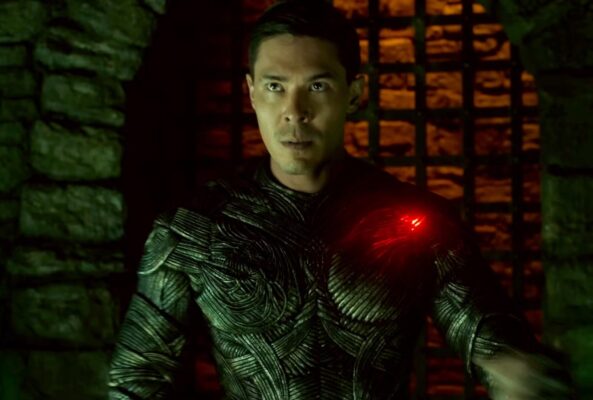
Unfortunately this also applies (albeit less dramatically) to McNamee, Ludi Lin as Liu Kang, and Mehcad Brooks as Jax; nearly all of the returning characters are given less to do and their screen time is much reduced in favour of folks like Kitana and Johnny Cage. It feels as if some of these legacy characters have only been brought back because fans expect them to be present, which is disappointing.
The result is a flawed, but watchable action/comedy film. Despite clunky storytelling, acting and direction, however, Mortal Kombat 2 remains a fun time, particularly if you’re a fan of the games. 2.5/5
Mortal Kombat 2 is playing in theaters on May 8
Leave a Reply