
The title ‘You Can See Everything’ is something of a misnomer in Nathan Fielder and Lance Oppenheim‘s documentary. Ostensibly the nearly three hour doc is about Theranos CEO and convicted fraudster Elizabeth Holmes in the days leading up to her prison stint, but the reality is far, far more complicated than that.
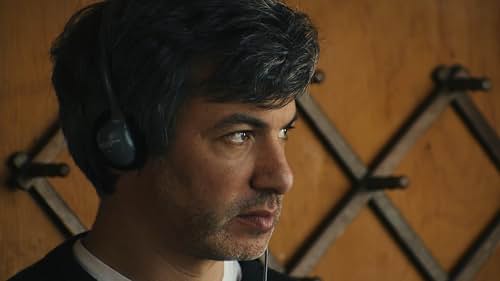
As someone who was only tangentially aware of Fielder’s previous output, You Can See Everything is an interesting introduction to his work. Fielder himself appears on screen frequently throughout the documentary, though his early scenes in the first act are all presented as horror/comedy jump scares. The camera will pan over to reveal that Fielder has been unexpectedly sitting or standing in the room (or just outside it) the whole time. Perhaps lurking is a better term: hunched over a monitor, eavesdropping with his headphones on, Fielder is constantly presented as a stalker who is listening to Holmes and her partner, Billy Evans, tend to their two children, field media inquiries, or prepare food.
It’s often good for a laugh, but the longer You Can See Everything goes on, the more obvious it becomes that the documentary is as much about Fielder as it is about Holmes. This is only partially a hard-hitting expose about what Holmes did or didn’t do as the head of Theranos, a company that defrauded millions from investors under the auspices of revolutionizing the medical testing industry using a single (dysfunctional) prototype that could perform dozens of tests.

It is about that, and Holmes, and Theranos, but You Can See Everything is also about Fielder and how he inserts himself into his own stories, and what he does and doesn’t believe. By accepting Holmes and Evans’ offer to live with them in the weeks before the start of her prison, Fielder positions himself as more than an interviewer or a filmmaker. He becomes a subject in his own work and Oppenheim is just as likely to capture Fielder’s perplexed/interested/outraged reactions as Holmes’ vacant, alien facial expressions or Billy’s condescending bravado.
The push and pull between memory, intent, lies, and truth forms the backbone of the entire endeavour. Fielder is initially interested in how Holmes perceives herself and her flat, endearing explanations seem childishly disconnected from reality. Meanwhile her entitled himbo partner works out, engages in questionable deal-making (capitalizing on Holmes’ notoriety) and provides the film with a rare glimpse of full frontal male nudity.
Arguably one of the buzziest early sequences occurs when Fielder presses Holmes to unpack how she defrauded investors and whether she’s ever told a lie. She’s adamant that she hasn’t lied – in any capacity – since she was a teen. The statement prompts one of Fielder’s rare unfiltered outbursts of shock, but it also leads him to interrogate Holmes on her selective word choice* and how others perceive her. In an effort to showcase how easily misunderstandings can occur in such conditions, Fielder cues up Abbott and Costello’s infamous “Who’s On First?” comedy bit.
*Words matter in the film. Another example is a quote from a NYT profile that Holmes stated she was playing “a character I created” – a line that he and Evans both adamantly refute, explaining she would have never said that. The veracity of those words will be repeatedly revisited throughout the film and the truth (or its accuracy) winds up being addressed in one of several post-scripts.
After watching the clip (and watching her watching it), Fielder quizzes Holmes about what she perceives the joke to be. The result is incredibly telling, as is the whole experiment. Evans is quick to make the suggestion that the way Holmes communicates and experiences the world is different from “regular” people, which is part of what makes her unique.
Refuting what was intended vs received, how Holmes and Evans remember events vs how they actually occurred, and how far down the rabbit hole Fielder will accompany them is the crux of the film. Somewhere around the middle of You Can See Everything, Holmes voluntarily surrenders herself to Federal Prison Camp Bryan in Texas and the film’s de facto protagonist/focus shifts from her to Evans.
There’s also a two year time jump (the doc was filmed over a period of three years) that forces Fielder, Oppenheim, and the audience to (re)adjust their perspectives about the doc’s focus. Suddenly Liz is impossible to reach or record; Evans is speaking – and acting – on her behalf in the real world, and an unlikely public figure steps into the film in a significant role(s) to help usher the drama along.
It’s in the back half that You Can See Everything shifts from an intriguing documentary about a potentially deluded woman to something far more interesting and complicated. The pull quotes for the movie initially read as hyperbolic, but the suggestion that audiences are unprepared for where the narrative goes, and the accompanying emotional rollercoaster ride, are all apt. The audience I saw the film with were alternately seething, gasping, and outright clapping at different points; these reactions more akin to a crowd-pleasing comedy or a terrifying horror film.
Perhaps You Can See Everything fits those descriptors? The film is a genre mash-up unlike any other documentary I’ve ever seen; it’s as much about Fielder and his magic show as it is about Holmes and Evans, and for all of those reasons, it’s a better, more complicated film. Despite a runtime of two hours and 59 minutes, the film that practically begs for multiple viewings, if only to see how Fielder pulls everything off. Because by the end of the film, it’s clear that the ones who have been duped, deceived, and toyed with are the audience watching the film.
If that isn’t a conversation starter and a reason to check out the film, I don’t know what is. 4.5/5
You Can See Everything is in theaters Oct 16
Leave a Reply