
James Cameron returns with his third Avatar film, subtitled Fire and Ash, which acts as a direct sequel to The Way of Water (for better and worst).
Love them or hate them, the Avatar films have a deep cultural footprint. Not only did the first two films in the series push the technological boundaries of the medium, but they have occupied Cameron’s time and energy for more than a decade and a half.
The latest film, Fire and Ash, is the least vital of the bunch, but most of the blame rests on the fact that it is essentially just the back half of The Way of Water (Cameron and co-screenwriters Rick Jaffa and Amanda Silver have stated that the concept for the second film grew exponentially and they eventually opted to split it in two).
For those who enjoyed The Way of Water, this likely isn’t necessarily a bad thing. It does, however, make the latest film, which clocks in at 197 minutes, occasionally feel like a drawn-out rehash of the last film.
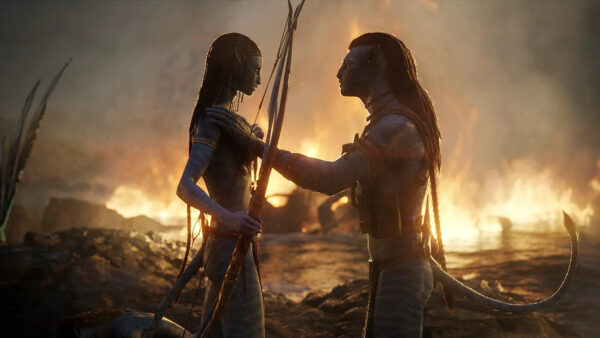
Be warned: Fire and Ash picks up in the immediate aftermath of The Way of Water with virtually no overview, so if audiences have forgotten, say, that that second film ended with the death of Neteyam, the oldest son of Jake Sully (Sam Worthington) and Neytiri (Zoe Saldaña), then the opening of the new film will leave you scrambling to catch up.
The film uses Jake and Neytiri’s second son, Lo’ak (Britain Dalton) as its narrator, though this narrative technique is used so sporadically that it tends to feel superfluous. As Neytiri grieves and distances herself from Spider (Jack Champion), their adopted human son, Avatar‘s main antagonist, Colonel Miles Quaritch (Stephen Lang) continues to butt heads with his superior, General Frances Ardmore (Edie Falco), who views his vendetta with Jake with disdain.
The new film continues these storylines, while expanding the intrigue and mystique around Kiri (Sigourney Weaver), whose ties to Eywa, the Great Mother, now induce epileptic seizures. Kiri was a significant figure in The Way of Water and she proves just as vital in Fire and Ash (on both a micro and macro storytelling level), specifically with regard to her attraction to Spider and her ability to call on the spiritual/natural elements of Pandora.
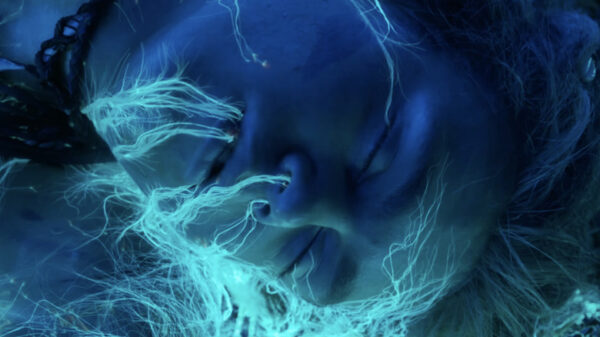
Spider is the other character who dominates the narrative. In addition to being caught between Quaritch and Jake, Spider’s inability to breathe without a battery-operated exopack is a huge liability in the first half of the film. Fire and Ash soon upends this in order to introduce a moral dilemma for Jake and Neytiri and turn Spider into a symbol for the battle for the planet against the encroaching humans, symbolized by Giovanni Ribisi‘s smarmy RDA head administrator, Parker Selfridge.
Naturally this all builds to another epic (and drawn out) climactic battle that requires the Na’vi clans to unify against the military might of the RDA. The outlier for this third go around, however, is an opportunistic new Na’vi group, the Mangkwan clan, lead by Varang (Oona Chaplin).
It should be noted that Chaplin is a fantastic addition to the franchise. Varang is dangerously unhinged and seductive character, and her alliance with Quaritch is fostered by their mutual love for power and destruction. Varang essentially worships the dark arts after witnessing the destruction of her people’s Hometree (cue the trauma response!), which has turned her against Eywa in favour of worshipping fire, body modifications, and hurting others using her queue (the neural tendrils hidden in the hair of most Pandora creatures).
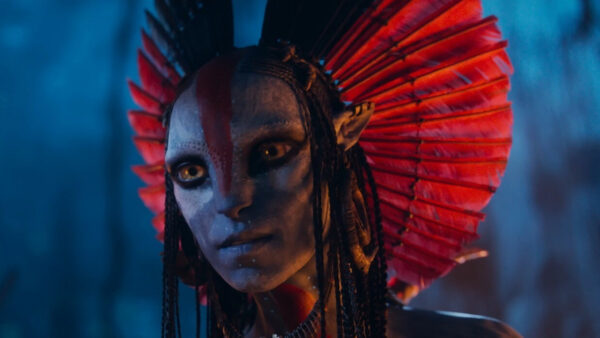
Part of what makes Varang intriguing is how unpredictable she is. Her scenes with Quaritch cackle with danger and her rivalry with Neytiri, a subplot that carries through multiple interactions over the course of the film, gives Saldaña something other to do than grieve and mope.
As for the other subplots, there’s more about the passivity of the Tulkun (the ancient, enormous whale-like creatures introduced in The Way of Water), as well as new Na’vi like the Wind Traders, who fly in on enormous floating ships and are led by new cast member David Thewlis as Peylak (who recurs in both Avatar 4 & 5).
Overall Avatar: Fire and Ash is unlikely to convert resistant audiences, but for those who enjoy the scope of Cameron’s fictional world and its eye-popping special effects, this is another solid outing. There is darkness and death in the tale, but the series (mostly) remains exciting family friendly holiday fare. Watching the spectacle on the largest screen available is still a breathtaking experience, even if narratively Fire and Ash feels like an expansion – or rather a completion – of The Way of Water, as opposed to its own standalone tale.
Still: a new James Cameron film is always welcome and clearly this is the sandbox he’s committed to playing in for the foreseeable future. We might as well accept it and try to enjoy it! 3.5/5
Avatar: Fire and Ash is in theatres Dec 19